Rilla's Founding Story
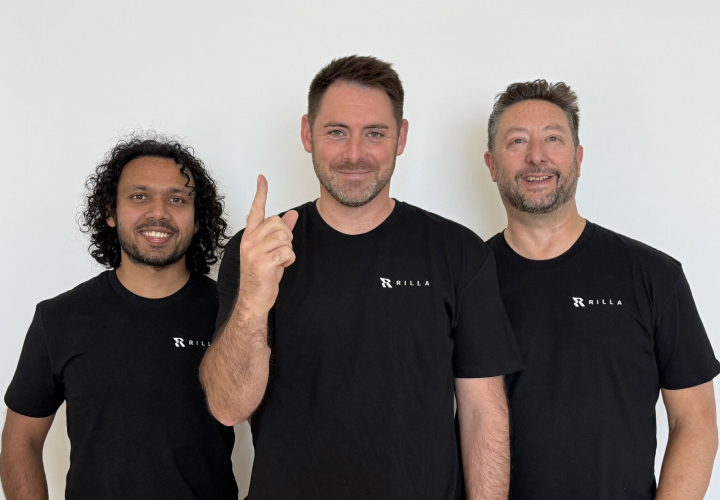
How a founding trio’s Venn Diagram of expertise became the foundation for the invention of “intelligent streaming”
Successful startups always seem to have some similar ingredients. An itch to scratch, a problem worth solving, enough capital to test the market, an ambitious goal, strong execution skills and possibly, most critically, a founding team with the will, skills and determination to hear “no” or “that’s not possible” and to make it so regardless.
Every meaningful shift in a business model also begins with a simple truth: the current system is broken or no longer viable.
In streaming, that truth has become clear. Today’s delivery cost model scales linearly - every new viewer increases the load on centralized infrastructure, and every audience spike pushes cost and complexity higher. As the price of premium content rights rises, broadcasters are also obliged to pay more. CDNs shoulder the pressure and viewers often pay the price with the spinning rebuffer of death AKA Quality of Experience (QoE).
The reason we can build this boils down to the rare intersection of the problem worth solving and the experience within our founding team.
This is why Rilla exists. To fix the business model problem that every streamer at scale faces. We’re building an AI-orchestrated, peer-to-peer infrastructure that augments Content Delivery Networks (CDNs), protecting quality at scale and enabling a more equitable flow of value throughout the ecosystem.
A serendipitously timed meeting and a perfect match of skills and experience coalesce to meet this opportunity:
The three people at the center of Rilla - CEO Hal Smith Stevens, CTO Pul Bandara, and CCO Justin Tomlinson “JT” - come from different corners of technology. Yet their strengths converge in a way that mirrors what modern streaming needs: deep technical engineering + global broadcast scale + a shared vision that there is a better way.
At that intersection is a simple conviction: the future of streaming belongs to companies that blend the best of machine intelligence, human participation, and battle tested infrastructure working together in harmony.
A duo with a decade of engineering critical realtime Systems
For more than ten years, Hal and Pul have been building complex, real-time systems where performance and reliability are non-negotiable: Healthcare delivery networks, low-level air traffic control systems, distributed, AI-orchestrated infrastructure.
This is not your usual CRUD, SaaS web development fodder. It’s engineering where quality of service and experience must hold - even under unpredictable load and when milliseconds matter.
Hal’s path evolved from builder to strategist to CEO, but he remains deeply technical. It is Hal’s ability to capture a vision, understand it from concept to code and articulate it clearly and compellingly that have seen him make that transition successfully and with some solid exits under his belt. Despite this, his passion and energy to build world changing solutions remains as sharp as ever.
Pul never left the code; it’s where he thrives. Pul has a prevailing calm even under pressure that permeates the teams he leads. His ability to take hard problems and engineer them into existence as a product is uncanny. He sets the benchmark in engineering rigour and excellence for the whole team and he seamlessly manages complex product engineering tasks without excess bureaucracy or waste. He is the architect of our delivery capability while always remaining grounded and focused on the goal.
Together, Hal and Pul share an instinct to simplify complexity, automate intelligently, and architect systems that reinforce existing foundations where required.
The FTSE 30 CTO who lived the problem up close
Justin Tomlinson (JT) brings the industry perspective from the other side - the operators who rely on CDNs to support some of the largest global streaming moments.
He’s worked with broadcast platforms and fan-engagement ecosystems that manage massive, unpredictable concurrency. He saw what happens when the software and hardware stack become a major commercial limitation:
- Costs rise linearly with every user
- Quality of Experience (QoE) dips under load
- Operators lose observability and predictability
- CDNs are placed under immense pressure
- Ultimately most live streaming companies lose money
None of these challenges reflect technical flaws in CDNs - they reflect the limitations of a model that has struggled to keep pace with demand while remaining economically viable.
This led to the moment that Rilla was formed. Uniting this unique set of skills and experience around a real business problem - JT understood the market and the business constraints. Hal and Pul had developed a strong hypothesis that they knew how to solve this problem technically.
Together, they recognized the same opportunity: not to replace CDNs, but to give them an intelligent augmentation partner.
The “Aha” moment: A collaborative layer, not a competing one
The breakthrough came when the trio met to talk about streaming’s structural business model challenge. If capital intensive centralized infrastructure is carrying the full weight of scale but the devices in our hands and connectivity between them is so good then the solution isn’t “more servers.”
It’s a complementary network layer that can be trained to “think”, adapt, and share load dynamically - and most importantly one that works alongside CDNs, not against them.
A layer where:
- AI orchestrates real-time peer routing
- Network participants contribute bandwidth intelligently
- CDNs are extended and supported, not replaced
- QoE stays consistent during audience spikes
- Cost efficiency improves as the network grows
This is AI-orchestrated, peer-to-peer streaming infrastructure - a collaborative layer that augments your current infrastructure to protect quality under peak times.
Rilla now has the team, the architecture, and the early funding to execute on this vision. But more importantly, we have the purpose: to strengthen the streaming ecosystem by reinforcing the infrastructure that already powers it. Not to replace, but to augment intelligently, predictably, and fairly.
In our words, to Unleash Our Internet.
Hal, JT & Pul