Every team building something genuinely new goes through a period of learning. You start with a conviction, put it in front of the people you want to serve, and they show you where the real value lies. In our experience, that’s the only reliable way to find it.
The past year at Rilla has been exactly that kind of journey. This post is about what we heard along the way and what we’ve done about it.
Late last year we wrote about why we show, we don’t tell. We built a live visualisation of a peer network forming, deflecting traffic, losing 20% of its peers in an instant and recovering without the viewer noticing, and we put it in front of some of the people who run the largest live streams in the world.
It did exactly what we hoped. It opened doors and earned us time with serious people. What we didn’t fully anticipate was how much it would change the conversations that followed.
Once engineers and executives had seen it working, the question was rarely “can this work?” any more. It became “how would this work for us?”, and the detail came thick and fast:
Anyone who has sat on the buying side of the table, as I have for most of my career, will recognise these for what they are. They’re the questions you ask once you’ve stopped wondering if, and started working out how.
They also told us something about our own approach. A demo is brilliant at proving a point, but it won’t get you through a security review, a procurement process or a platform team’s overflowing backlog. We’d shown people the outcome; we hadn’t yet given them the path to get there. So our amazing team got their heads down and built it.
Those conversations kept coming back to the same underlying issue: the economics of live, and why they matter more today than they did a few years ago.
For much of the last decade, delivery costs looked like they would take care of themselves. CDN transport and cloud egress were in a race to the bottom, and it was reasonable to assume the cost of moving video would just keep falling.
That’s no longer the case. Data centre investment has shifted decisively towards GPUs and AI workloads, and delivery capacity is now competing for the same power, space and capital. Transport and egress pricing has bottomed out and, in places, has started to climb again.
At the same time, the volume of content that needs delivering is set to grow. AI-generated content is proliferating, and it will find its own niches in live, adding concurrency and traffic that simply didn’t exist before.
At the top of the market, live sports rights continue to consolidate into fewer, larger hands, paying more for the privilege. Those rights holders have every reason to protect the value of each event, and very little tolerance for anything that puts quality, security or revenue at risk.
Put those together and the CDN-only model gets harder to justify. Cost grows in step with the audience: every additional viewer, every extra minute and every step up the bitrate ladder adds more CDN-served traffic. Capacity is reserved for the busiest few minutes of the year, and the true cost of an event is often only known after the audience has already arrived.
Live has one characteristic that model doesn’t take advantage of: most of the audience is watching the same segments at roughly the same time. If those viewers can safely relay segments to one another, a single segment served from the CDN can support many viewers instead of one.
This is the thinking at the heart of Rilla. Every viewer who joins brings a little delivery capacity with them, so audience growth no longer translates directly into transport spend.
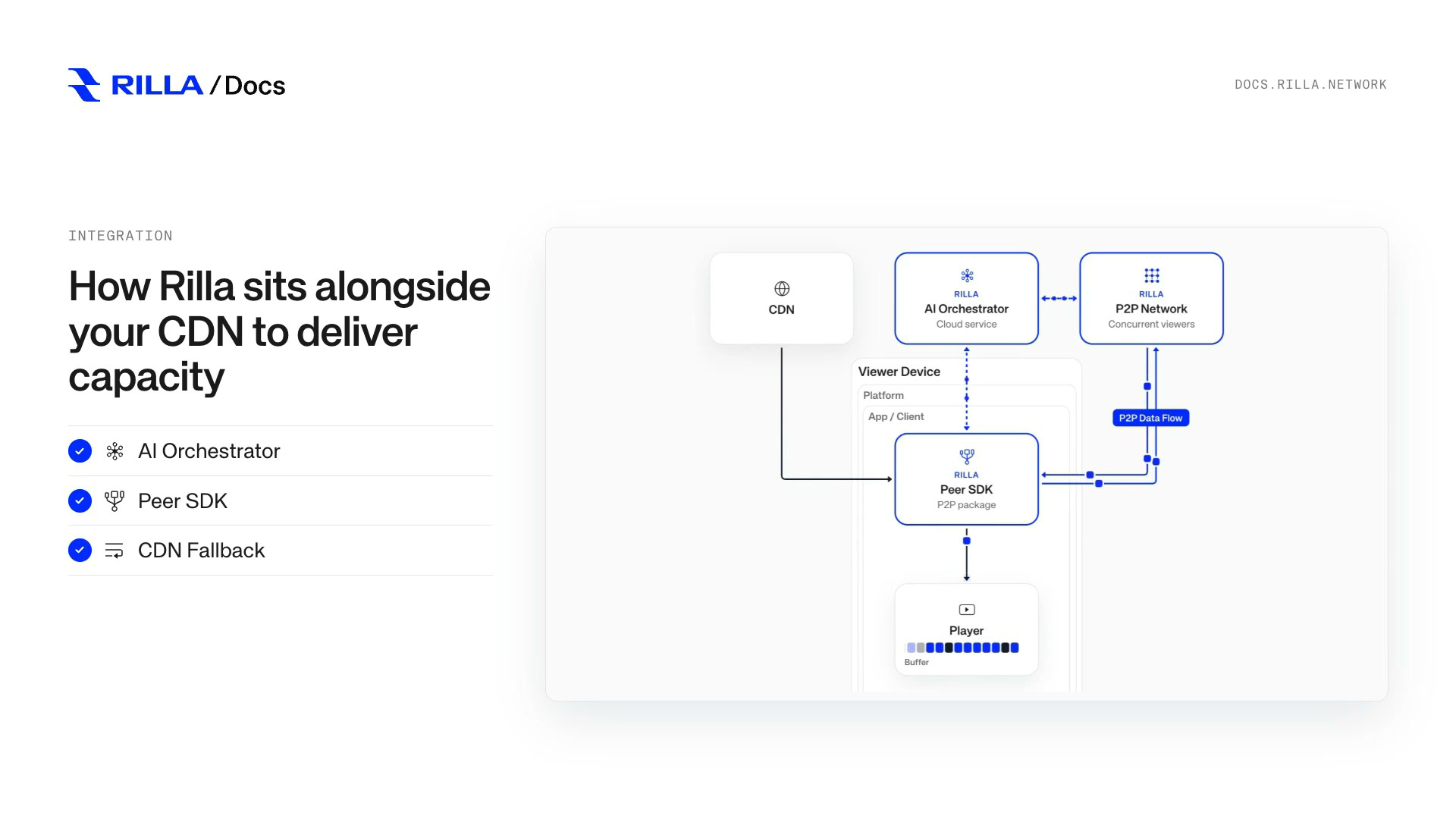
In suitable live conditions, it only takes a relatively small proportion of the audience to contribute for Rilla to achieve 60–90% CDN deflection while keeping quality guardrails steady.
Given what’s now being paid for the rights, cost savings mean nothing if the experience suffers, the content is exposed or the revenue model breaks. So it’s worth being specific about what “no compromise” looks like for us:
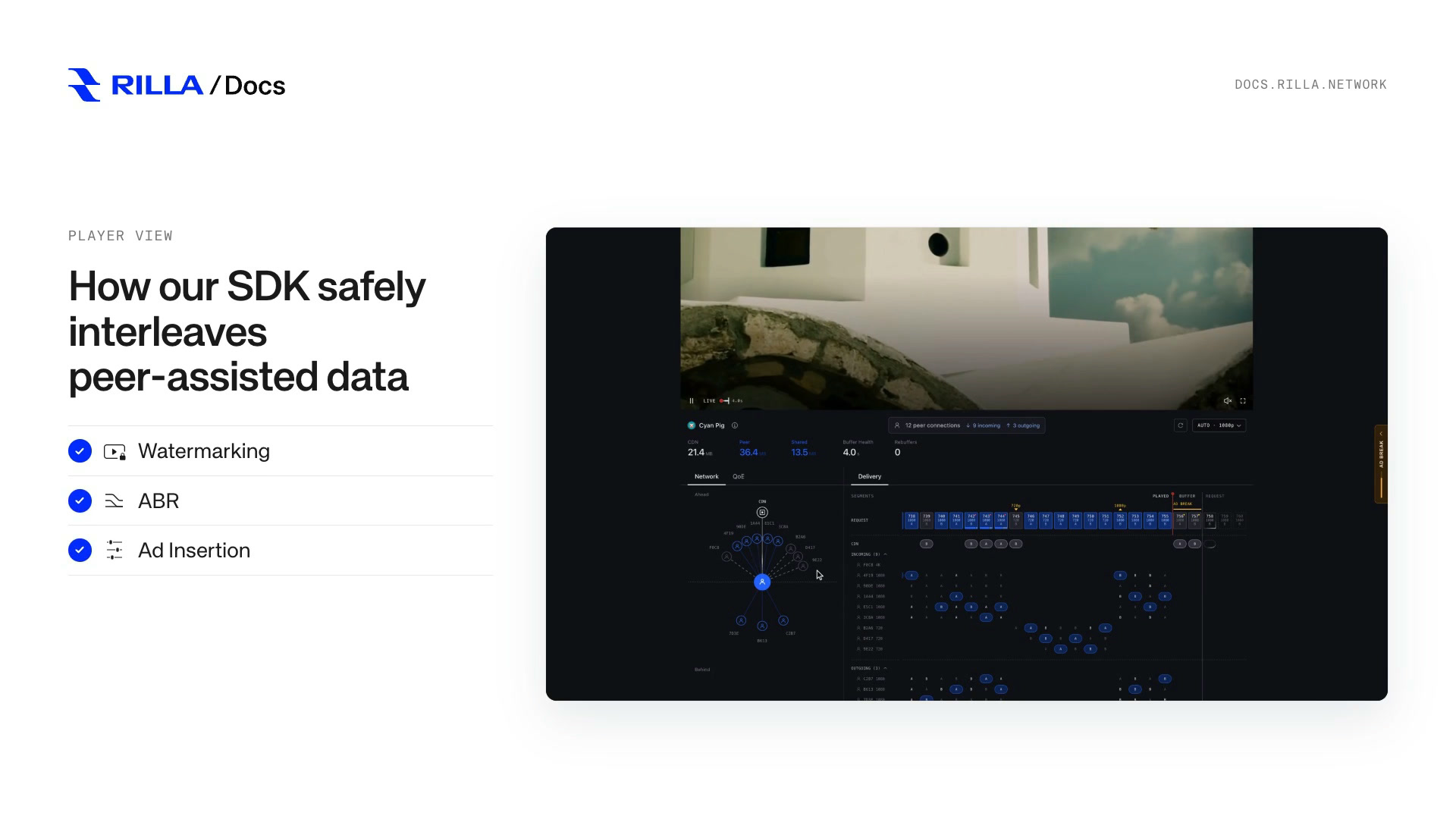
We’d also rather be upfront about one thing. We’re not chasing the biggest deflection number at any cost. There are moments when a lower figure is the right result, because fallback has just protected someone’s stream. We measure deflection against a CDN-only control as a genuine business outcome, and that’s how we think it should be judged.
What that adds up to is something many in our industry have long considered out of reach: a viable way to bring down the cost of delivery at capacity without giving up the quality viewers notice or the monetisation rights holders depend on.
There’s a real advantage in having a product that has matured. With the core technology proven and stable, we’ve been able to step back and put serious effort into crystallising everything around it: the knowledge, the integration detail and both the commercial and the technical case.
docs.rilla.network is the result, and our answer to the questions our customers kept asking. It brings our commercial and technical content together in one place, written both for the people who make the decision and for the people who have to make it work.
Open to everyone:
For integration partners (gated content on request):
For access, reach out or request access here.
It also means the demo visualisation we featured last year has made way for two new demos that go considerably further.
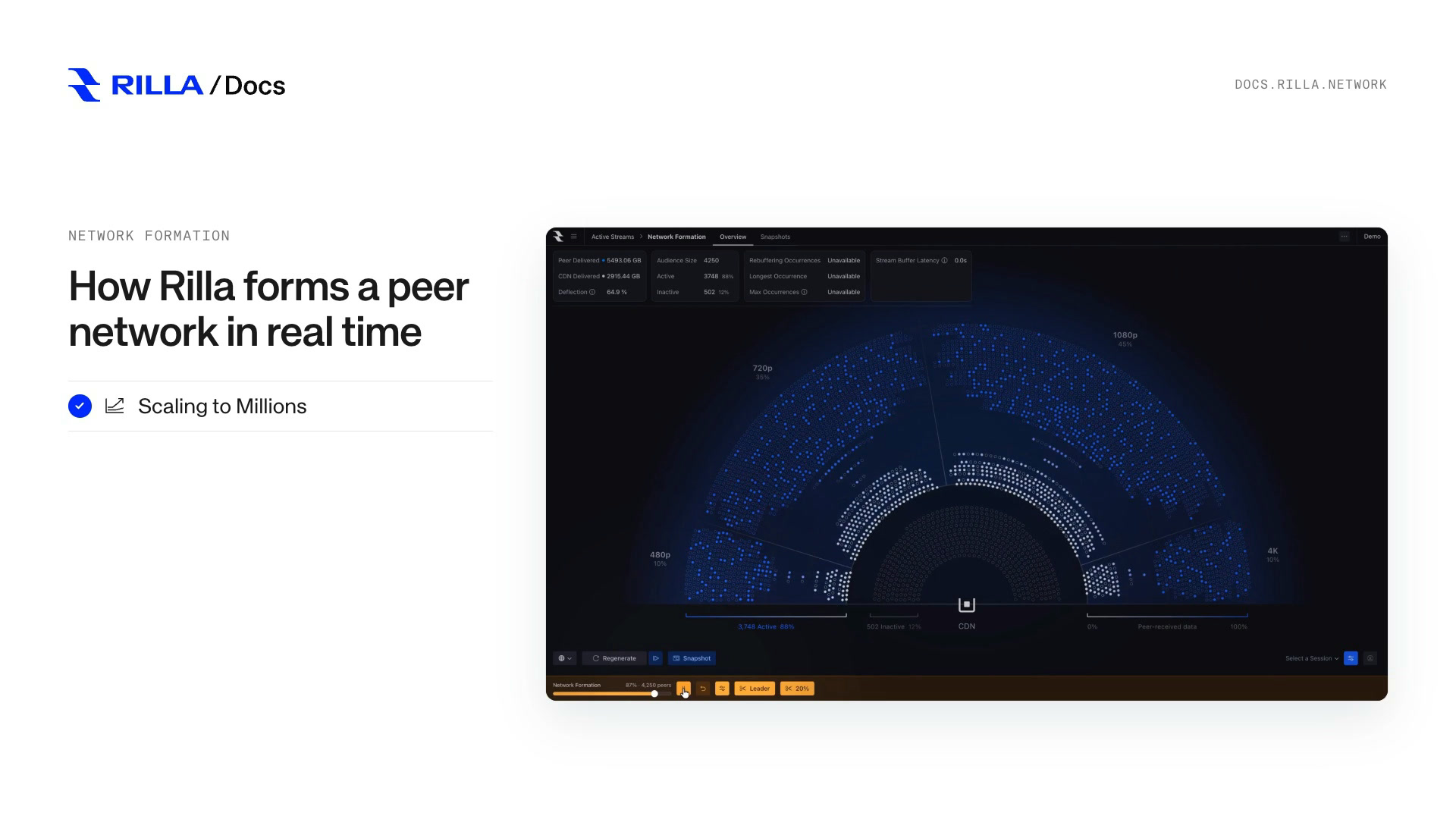
The original demo told the network’s story. The new ones tell the viewer’s story too, and that’s the part a platform team ultimately has to sign off on.
We still believe working software beats any sales deck. The difference now is that the detail behind it is there for anyone to read, test and challenge.
There’s not much point writing good documentation if people have to go hunting for it. rilla.network now surfaces this content far more easily: the commercial pages, the trial guide and the videos are open to everyone, rather than tucked behind a contact form or a first call. The integration docs are gated: partners get access on request. If you’d prefer to do your homework on us before we speak, you now can.
For us, being adaptable has never meant reinventing the company every quarter. It means staying focused on the problem and letting the people who live with it every day shape how we solve it.
The economics of live has always been that problem. Our customers told us what a credible answer needed to look like, we listened, and we’ve now published it for anyone to scrutinise.
The cost of live delivery no longer has to rise in lockstep with the size of the moment, and we’re ready to prove that in your environment.
Justin Tomlinson

